The Mitsubishi Lancer Evolution V(5) is, you could say, the point where the Evo truly evolved into the road-going monster we all know and love.
Despite being based on the same sixth-generation Mitsubishi Lancer as its predecessor, the Lancer Evolution IV – and notwithstanding the fact that it shared the famous 4G63T engine (albeit with a host of performance upgrades) and all-wheel-drive layout of every Evolution model before it – the Evo V has the iconic, bulging silhouette that most nineties car fans imagine when presented with those three magic words – Mitsubishi Lancer Evolution.
Yes, the technology has evolved since the very first Evolution model hit Japan in 1992. But in a way, the essence of the Evo V is all in its almost confrontational look. The aggressive, purposeful styling arguably gives this car as much of its iconic status as the many motorsport wins in the hands of legendary rally drivers such as Richard Burns and Tommi Mäkinen. In other words, it’s the Evo that changed the game in terms of mainstream perception.
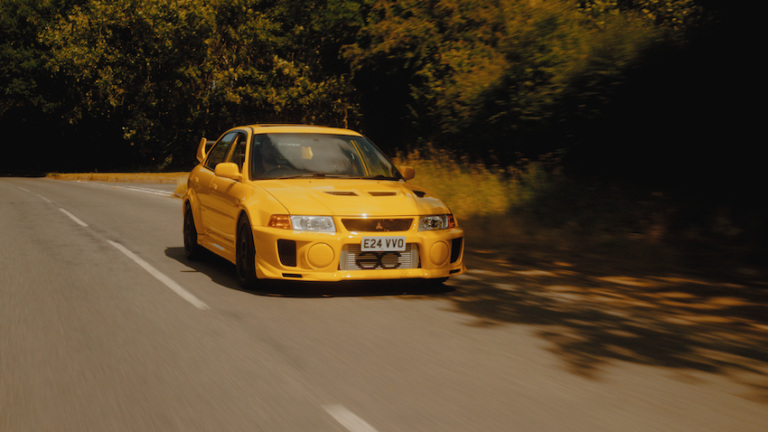
With those legendary flared arches – designed to accommodate a significantly wider track for Group A rally regulations – and featuring a huge adjustable alloy rear-wing and 17-inch OZ Racing alloys housing massive Brembo brakes, what’s perhaps most important of all is that this homologation special captures the moment when the Mitsubishi Evo really started to look like the Mitsubishi Evo.
The Evo V, of course, also introduced the modifying icon that is ‘that’ bonnet vent. An aftermarket behemoth that took on a life of its own and found itself as a central feature on many, many tuner cars over the decades to come.
Essentially then, the Evo V is the original truly wild Lancer. The first of many, but the version that made the wider car world sit up and take notice of what hardcore rally fans had known all along: there’s no doubt the Evo is a demon on the World Rally Championship (WRC) stages, but it’s even better where it matters most – on the streets.
For fans of the craziest of modern classics, the fifth-generation Lancer Evolution is one of the most loved of all the Evo models. Arguably second only to the iconic Tommi Mäkinen Edition Evo VI that saw out the rest of the nineties and (due to WRC rule changes) became the last that needed to be homologated for rallying. Notably, the Evo V was also the first to be officially available here in Europe through Mitsubishi’s performance arm, Ralliart. After seeing how popular the previously JDM-only Evolution models were on the grey import market, it was only a matter of time before Mitsubishi made them available outside Japan via the Ralliart dealer network. A move that has only bolstered its popularity and iconic status on our shores.
But, of course, we shouldn’t merely skip straight to the good part, because the Lancer Evolution V wouldn’t have been possible if not for the Evo I, II, III, and IV that preceded it. The initial idea was to build a compact competition car for the tight, winding rally stages around the world.
Previously Mitsubishi had fielded their all-wheel-drive Galant VR-4, but it proved too heavy and cumbersome for the job. Smaller, lightweight cars were becoming more and more desired to stay competitive. Around this time Subaru were replacing the Legacy with the Impreza, Ford were replacing the Sierra Sapphire with the Escort Cosworth, and Toyota was looking to replace the Celica with the Corolla. So, Mitsubishi was in good company, and downsizing was clearly the name of the game.

As Mitsubishi had seen plenty of success in the 1970s and 1980s with their compact rear-wheel-drive (and later front-wheel-drive) Lancer, the solution was simple – merge the Galant and the Lancer for a world-class homologation special.
By taking the 244bhp, 2.0-litre, turbocharged four-cylinder engine and all-wheel-drive (AWD) drivetrain from the Galant, crowbarring it into the (now fifth-generation) Lancer, and adding a few functional touches such as bonnet vents and a subtle aero pack, the first-generation Lancer Evolution was born. Most importantly, this was classed as a completely different model to the Lancer and Mitsubishi had to sell 5,000 road-going cars just to compete. But this was no problem in their home market and the Evo I became extremely popular around the world as a grey import, too.

Aside from a few embellishments, the Evo I looked exactly like the car it was based on. It’s the same story with the 1994 Lancer Evolution II and the 1995 Evolution III. Performance-focused upgrades aside, they were all reasonably subtle. The 1996 Evolution IV, which was by now based on the sixth-generation Lancer, was a little more beefed up but still relatively restrained compared to our hero car which came along in 1998.
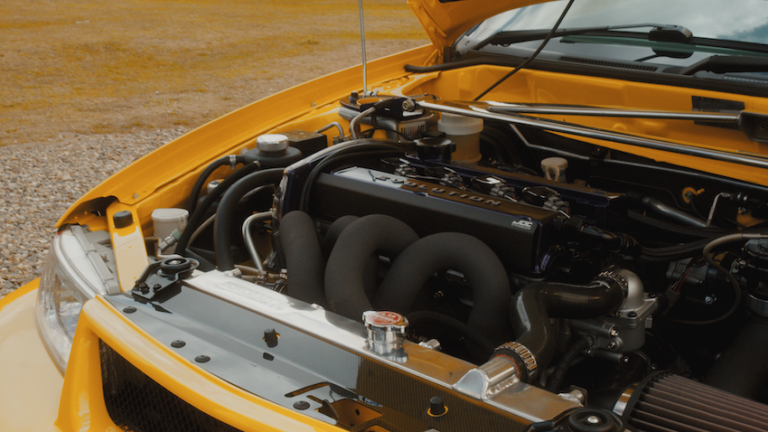
For the Evo V there were sweeping changes inside and out. Not least the full wide-arch kit, new headlights, bonnet, Recaro bucket seats, and a power hike to an ‘official’ 276hp. This was, of course, keeping with the well-known gentlemen’s agreement between Japanese car manufacturers to limit power figures on their models… or at least the ‘advertised’ power figures. Everybody knew that the Evolution V had much more, as did every Evo that came after. Significantly, the arches were also so wide that it was no longer classed as a compact car in Japan. Although that didn’t harm its popularity, either. When the Lancer Evolution V launched – not just in Japan, but all over the globe – it became the template for the most outrageous road-going saloon cars for years to come. And that’s not a bad slice of cultural impact for a car that was only made for a year between January 1998 and January 1999.

Of course, there are many stories we could ponder about what has made the Mitsubishi Lancer Evolution range iconic in the decades since the introduction of the Evo V. Not least the later models featured in the Fast and Furious franchise (did someone say drifting?), or the ultra-powerful ‘FQ’ models built by Ralliart specifically for the UK market… and, indeed, the urban myth detailing exactly what FQ stands for. But without the Evo V, it’s unlikely that any of these motoring icons would have ever existed.
The truth is the Lancer Evolution V was far from the first Evo, but it was the first to make the Evolution badge transcend mere motorsport into a bona fide mainstream motoring icon. For that reason alone, it deserves its place in the nineties high-performance hall of fame.