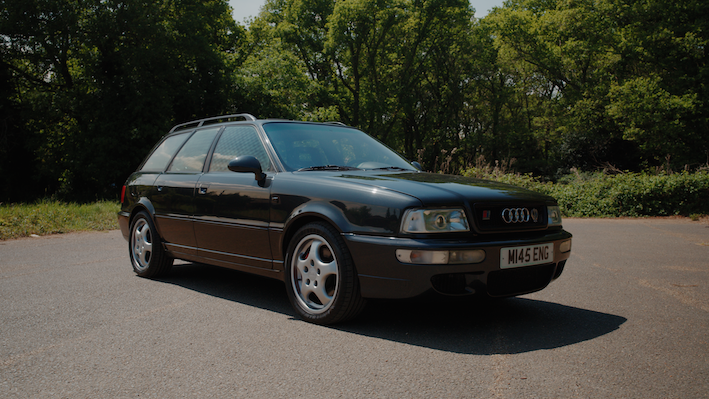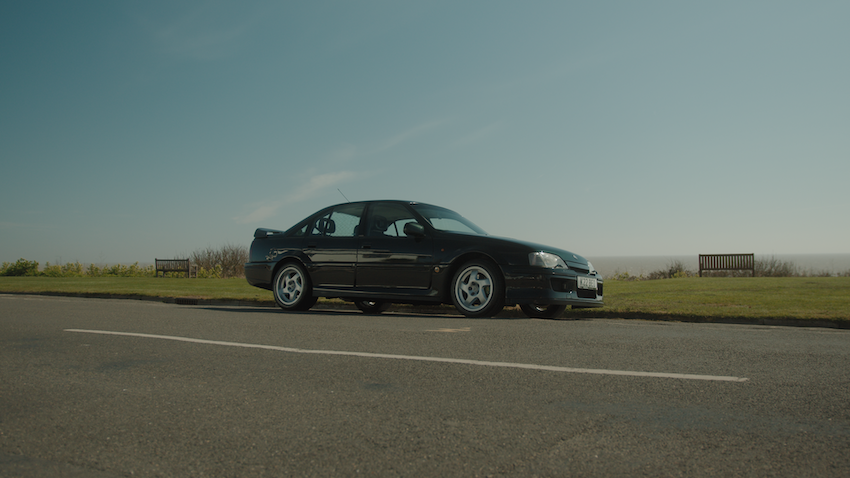
The Lotus Carlton wasn’t the first fast four-door saloon car. After all, by the time this particular motoring icon hit the streets in 1990, the super-saloon era was already in full swing.
The big Lotus bruiser did however crowbar a whole new level of insanity into the marketplace and make its own mark, simply by putting a full-size land barge into bona fide supercar territory. The truth is that mere ‘super-saloon’ is too meek a title for a car that – here in the UK – the Association of Chief Police Officers and (somewhat predictably) the Daily Mail immediately called to be banned. And that was before it was even on sale.
While the concept of factory tuning a production car was nothing new, this collaboration under the General Motors umbrella pushed the idea of combining world-beating performance with a humble saloon car to the limit.
We’re talking genuine supercar stats for the Top Trumps generation. A factory four-door faster than many purpose-built sportscars of the day, much to the dismay of big names like Ferrari and Porsche.
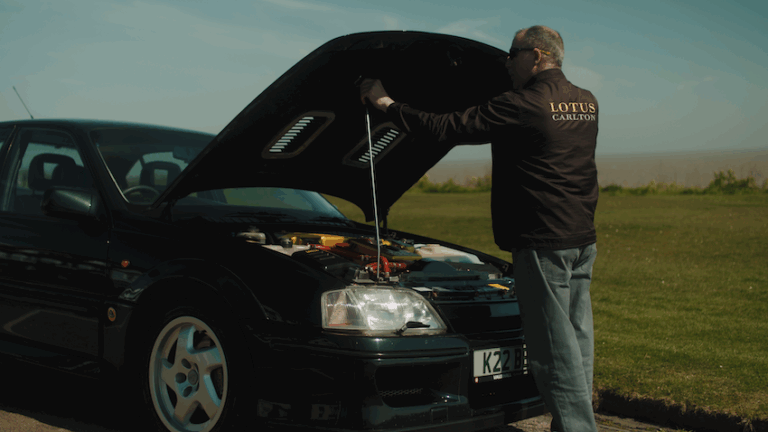
But, perhaps most importantly this large saloon car actually looked dramatic and – dare we say it – fast. What Vauxhall penned and Lotus perfected was less of an understated, sportscar-beating sleeper and more of a rowdy, supercar-baiting sledgehammer.
The standard Vauxhall Carlton was big, heavy, a little cumbersome and, well… not very ‘Lotus’ at all. But the fact this upgraded version was conceived by a British engineering company known for small, lightweight cars that were chiefly designed around poise and handling, only adds to the charm of implementing such an extraordinary idea.
Of course, if we’re talking solely about the fastest production saloon cars of the early 1990s, there are other noteworthy models. The legendary BMW M5 was already onto its second generation, the mighty Sierra Sapphire Cosworth had been around for a couple of years, and the burley Mercedes 500 E was quite the monster in terms of power and torque.
But sheer grunt aside, these early super-saloons remained relatively subtle and unassuming – the automotive equivalent of the wolf in sheep’s clothing. And that was the whole point.
The Lotus Carlton on the other hand, was styled to look exactly like it was – a car that’s all about brute force. The fact it was anything but subtle gave this fast four-door plenty of presence, and a whole load of kudos, as soon as it was launched. Its iconic status has only been compounded more than 35 years later.

Of course, right now in the modern era, we’re used to seeing the likes of the Audi RS6, BMW M5 Competition and just about anything with an AMG badge shouting (loudly) about their hyper-saloon credentials. Huge wheel arches, snarling grilles and aerodynamics to rival the fanciest of private jets seem to come as standard nowadays.
They more than allude to the huge power lurking under the bonnet and, in many ways, that’s thanks to the Lotus Carlton. After all, back in the ‘90s the beefed-up exterior upgrades developed by Lotus and fitted to a mere Vauxhall (of all things) were a novel concept to say the least. But it’s not just because it was the first production car with a ‘saloon on steroids’ look that gave this home-grown hyper-saloon its rightful place in the crazy creations hall of fame. The Lotus Carlton had the performance to back it up. And then some.
This car was never about offering a selection of plush options and driver comforts. Lotus engineering – which, like Vauxhall and Opel, was owned by General Motors in the early ‘90s – were intent on doing their own development without the need for outside opinions and focus groups.
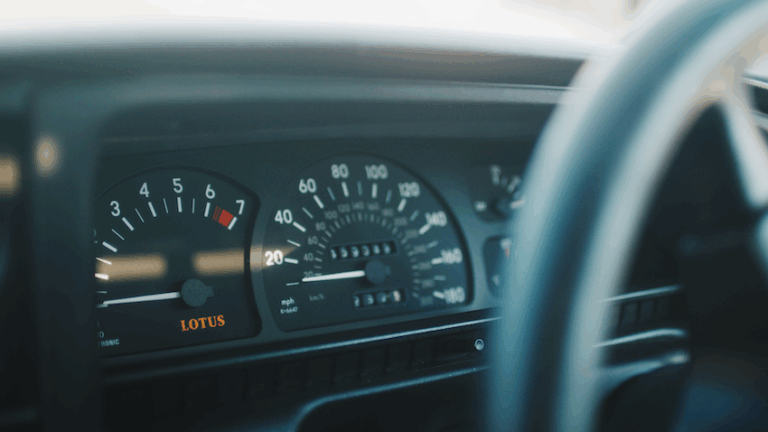
They were simply given free rein to draft in 320 Vauxhall Carltons (along with 650 Opel Omegas for the European market) and then push them to their absolute limit. In other words, they took these finished, road-ready cars, stripped them back and created their own vision. It may have been the expensive way to build a production vehicle, but it also meant that – for your £48,000 – you got exactly what you were given. Every car rolling off the line resplendent in Opel imperial green.
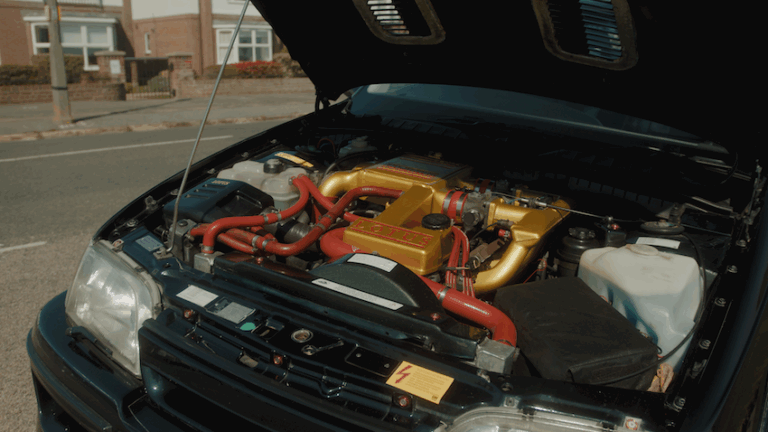
Although, let’s just say what you were given is what’s scientifically referred to as ‘a lot’. The body kit, wide arches and a host of parts from some of the top aftermarket manufacturers we know and love in the modifying community today. Not least high-end trinkets such as brakes from AP Racing, special Ronal alloy wheels and forged pistons from the world-renowned motorsport engineers at Mahle. But it was the hand-built powerplant (by one of only five Lotus engineers in their Norfolk factory) where the Lotus really excelled.
They took the 3-litre, 24-valve engine from the Carlton GSi, strengthened the block, increased the capacity to 3.6-litres… and then strapped on a duo of Garrett T25 turbochargers for good measure.
The result was 377bhp, a top speed of nearly 180mph and an almost ridiculous 0-60 time of 5.1 seconds. Significantly quicker than any other performance saloon of the day, fast even by modern standards, and just half a second or so shy of the acceleration of the 5.7-litre V12 Lamborghini Diablo, one of the craziest hyper cars of the era.
By drafting in more parts from other GM heavy hitters around the world – such as the gearbox from the Chevrolet Corvette ZR-1 and limited slip differential from the Holden Commodore V8 – the Lotus Carlton was also given its most famous of party tricks, it could hit 55mph in first gear!
And let’s not forget all this was right at the start of the 1990s, in a car capable of carrying four passengers, along with a chest of drawers or two in the boot. For much of the decade the Lotus Carlton held the record for the world’s fastest four-door production car, too. So, surely that was enough to seal its fate and put it right up there with the most popular performance cars of the day, right?
Well yes, you would think it was a cut and dry victory for General Motors and an inevitable triumph in sales. But, despite how we view this motoring icon with the benefit of hindsight, a price tag significantly more than a Honda NSX, the fact it was based on a such familiar Vauxhall family saloon, and the small matter of a nationwide recession, meant the Lotus Carlton wasn’t quite as popular as expected. Getting them off the forecourts turned out to be quite the tough sell, and disappointing revenues even meant Lotus had to cut production short by 150 cars. It was a run that lasted just two years before being halted at the end of 1992.
All this goes a long way to explain the rarity value, and indeed the iconic status, now in 2025. You’d be hard pushed to find any Lotus Carlton for sale, and you can double the original price if you do.
But perhaps this isn’t what made the big Lotus truly notorious and one of the most talked about cars well into the 2000s. That can be attributed to its popularity with joyriders, car thieves and such other nefarious individuals needing the perfect getaway car. In short, the police simply couldn’t keep up… even with a helicopter.
It’s estimated a significant portion of the 950 cars sold were targeted and subsequently stolen, many being used in other crimes. One of the most well-known stories is that of ’40 RA’ , a Lotus Carlton that was used for a series of ramraids in the West Midlands during 1993. Even the police had to admit “We simply haven’t been able to get near the thing, and it looks unlikely that we ever will.”
But let’s not dwell or tarnish the legacy of one of the most important automotive creations of the ‘90s. Not to mention one of the most important saloon cars of all time. What makes the Lotus Carlton so iconic is that nothing even remotely similar came before it. The idea of building a four-door production car to not only perform like a supercar, but look like one too, was way ahead of its time. In other words, this car led directly to all the crazy-looking hyper saloons we’ve had ever since.
When you think about it, there’s a little Lotus Carlton DNA embedded into each and every one.