Few cars have had such an enduring impact on the performance motoring world as the mighty BMW M3. The badge itself is arguably one of the most famous and most popular performance nameplates to ever come out of Germany.
Quite the accolade, considering we’re dealing with a nation that not only produced the Porsche 911 and a long line of Mercedes AMG models (not to mention the iconic Golf GTI), but is also notorious for a distinct lack of speed limits on the motorway.
Put simply, there’s a reason that German performance models tend to be faster and more refined than most of their peers. And that was a concept that was even more prevalent back in the 1990s.
The BMW M3 may not be the original M-badged Autobahn bruiser (a distinction that goes to the M1 in 1978). It’s not even the first ‘M Car’ based on a production model (that would be the 1979 M535i or the 1984 E28 M5, depending on which side of the debate you sit). But the magic of the M3 has always been instant recognition and its relatability because of the rather humble car that it’s based on. The BMW 3 Series is, after all, a benchmark when it comes to rear-wheel-drive fun cunningly disguised as everyday motoring. It’s also a model famed for offering a choice of trim for every driver and every facet of daily life, even if the M3 versions have always been an entirely different animal to the rest of the lineup.
What’s most important is that, over six generations, everyone’s favourite beefed-up 3 Series has become synonymous not just with fast road performance but with a sense of luxury, taste and more than a little motorsport prowess. After all, the M itself stands for motorsport, so it’s obvious that there’s plenty of racing DNA in every M3, along with every other BMW with the iconic M badge on the boot lid.
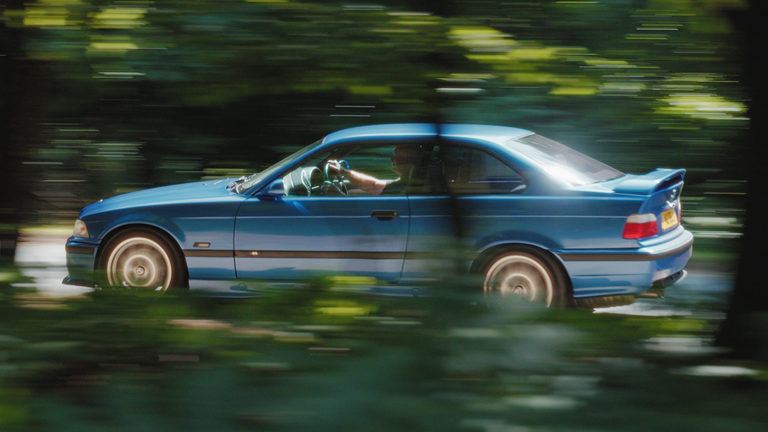
When it comes to the M3 itself though, even BMW M (the in-house performance division that conceive, design, and build each of them) couldn’t have predicted creating such an enduring legacy when the first – the E30 M3 – rolled off the production line in 1986. So, you would think the most important M3 of them all would be this one, the very first to sport the badge. But we beg to differ. We’d wager that none have been quite so influential, or had the sheer cultural impact, as the second generation model built between 1992 and 1999: the E36 M3.
The main reason for this indisputable fact isn’t just that the E30 was a genuine wide-arched, limited-edition homologation special for touring car racing, where the E36 was a widely available, and far more reserved, well-rounded production road car. More of an understated gentleman than a daredevil racing driver, even if the E36 M3 was far more powerful than its predecessor. But even more than that, the E36 M3 is a cultural icon for us personally – aside from its German roots it was essentially one of ours.
Let’s just forget what happens in Europe and the US, because what made the E36 M3 particularly special was that it was the first available straight from the dealership here in the UK. In other words, it came with the steering wheel in the right position for us here in Britain, and by that, we mean quite literally on the right.
Sure, we’d all have loved to have the original E30 M3 on our shores, it’s a 1980s icon in every sense of the word, but the E36 is what made M3 ownership here not just desirable for real-world daily driving, but extremely practical too.
The all-important right-hand-drive option aside, the E36 also started the straight-six tradition that’s since become intrinsically linked with the iconic M3 badge. This was the first M3 to be built entirely around a race-derived, technology-packed inline six-cylinder engine. It’s also the first to offer a choice of body styles. After initially being available as a two-door coupe, a convertible and four-door saloon version followed within a couple of years. The M3 then was all about amazing performance in an understated, refined and practical package. And, while the 286hp served up by the 3.0 S50 engine (from 1994, a 3.2 S52 engine with 321hp) isn’t bonkers by the standards of the current M3 models, it was more than a little fruity and capable of passing just about anything on the road back in the 1990s.
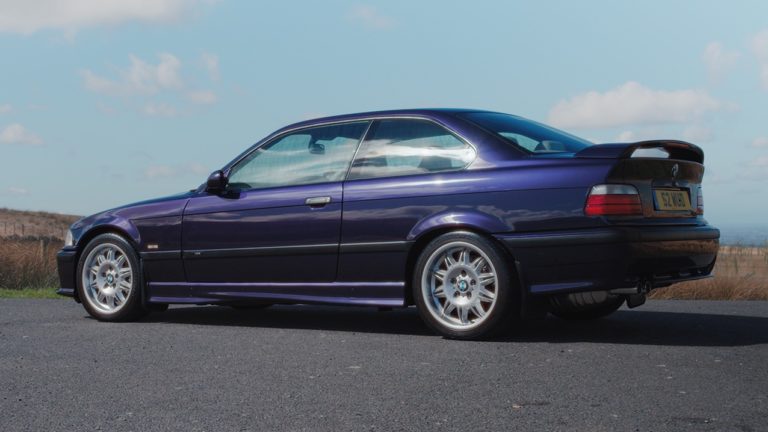
The E36 M3 was truly the archetypal wolf in sheep’s clothing, and for many that proves its most enduring legacy. The idea that you can take a practical rear-drive family car and have a lot of fun taking on all comers is a legacy that would make any manufacturer extremely proud. But for many others, none of that really matters.
You see, above all the technology, the performance, the handling poise, all those special editions and the sheer kudos of parking the flagship 3 Series on your drive, those firmly entrenched in the modifying community will tell you that the E36 M3’s real gift to the world of motoring myth and legend was something far simpler — the wing mirrors.
That’s right, forget the fact the E36 was nothing short of a technological marvel, and let’s disregard its practicality, desirability, success in racing, and all the championships it picked up among the world’s many touring car series. The E36 M3 will go down in history as the car that spawned thousands upon thousands of replica door mirrors fitted to just about every modified car on the streets. Everything from Ford Escorts to Vauxhall Corsas and Citroën Saxos to lower-spec BMWs, and for decades to come, too. For this alone, the E36 M3 had a cultural impact that far outlasted the production run itself, and that’s just for one simple piece of impeccable aerodynamic design lovingly crafted in ABS plastic!
But of course, we can’t focus entirely on the mirrors (or indeed the side skirts and front bumper) that became a multi-marque modifying staple in the 1990s and 2000s. Or the fact they somehow paved the way for the more recent BMW innovations that found their way into the aftermarket over the next three decades – everything from E46 M3 mirrors and ‘angel eye’ headlights, to E92 M3 bonnets and the ‘snake eye’ headlights on the current G80 M3.
The truth is there are many reasons why the BMW E36 M3 is a bona fide performance icon and one of the most important cars of the 1990s. There are also many reasons why it started the cult following for the M3 badge, particularly here in the UK, and single-handedly created the kind of BMW heritage that has directly translated into popularity and brand loyalty for the long line of cars to sport the M3 nameplate ever since. Young or old, motorsport enthusiast or casual driver, everyone knows what the M3 badge is and exactly what it means. And that wouldn’t have been possible without the most iconic 3 Series of them all – the legendary E36 M3.